


The EU GARAN label: what applies now and what comes next
The GARAN label shows a free, whole-product producer guarantee longer than two years. What sellers must display since 27 September 2026, how the label works, and where national laws stand.


The EU GARAN label is the official label for a producer guarantee that is free, covers the whole product, and runs for more than two years. Member States had to apply these rules from 27 September 2026, and from that date sellers must prominently display the GARAN label for qualifying guarantees when the producer makes the relevant information available. Its formal name is the harmonised label for the commercial guarantee of durability.
Separately, businesses selling goods to consumers in the EU have to show a standard notice about the legal guarantee. Both duties reach sellers through national implementing law on the same footing, so both are affected where a country is late. The legal guarantee itself is not new: what is new is the standard format that makes it visible, and the national laws that enforce it.
Both duties come from Directive (EU) 2024/825, the same law behind the EU's new greenwashing rules. The exact design of the notice and the label is fixed in Commission Implementing Regulation (EU) 2025/1960, which sets what they look like but imposes no display duty of its own. This update covers what applies now, how it differs by country, and what is still changing.
What is the difference between the GARAN label and the legal guarantee notice?
The notice is about rights every consumer already has. The GARAN label is about a promise one producer makes on one product.
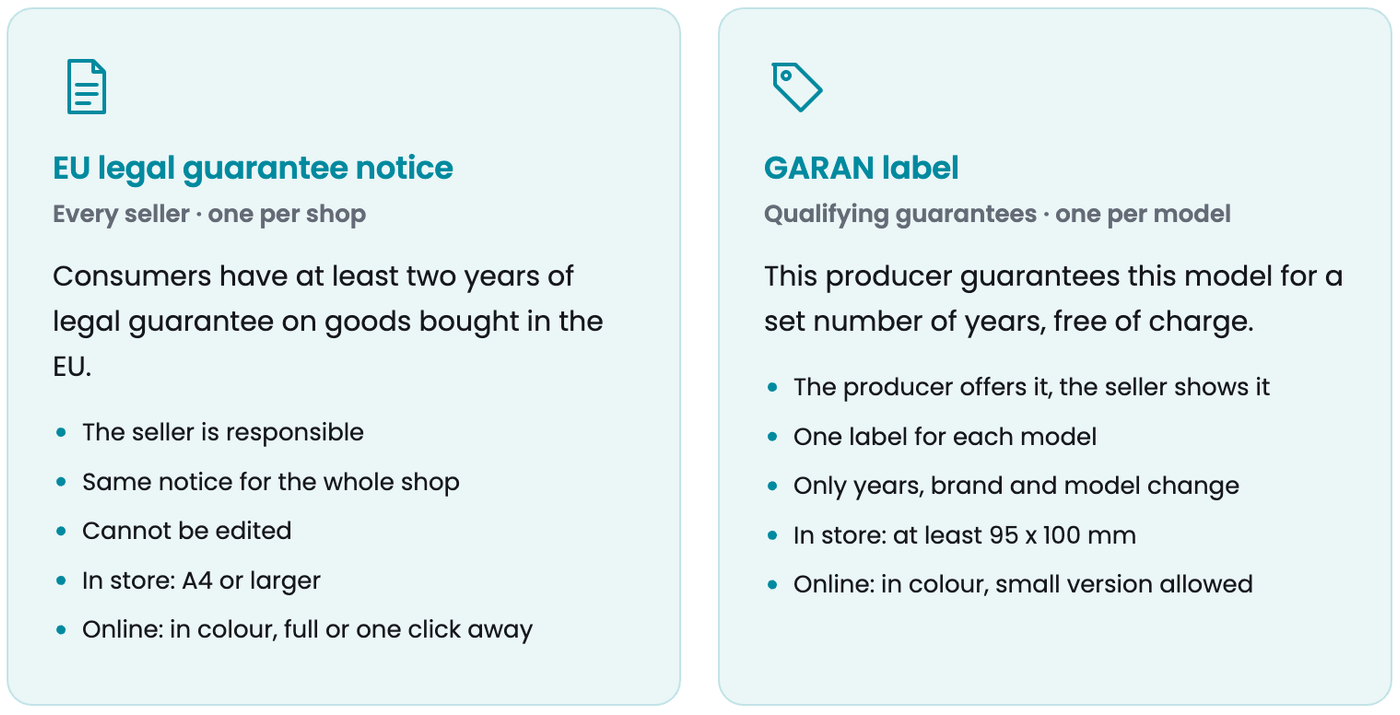
Both carry a QR code to an EU information page on the Your Europe portal, not to your website.
Do you need a GARAN label?
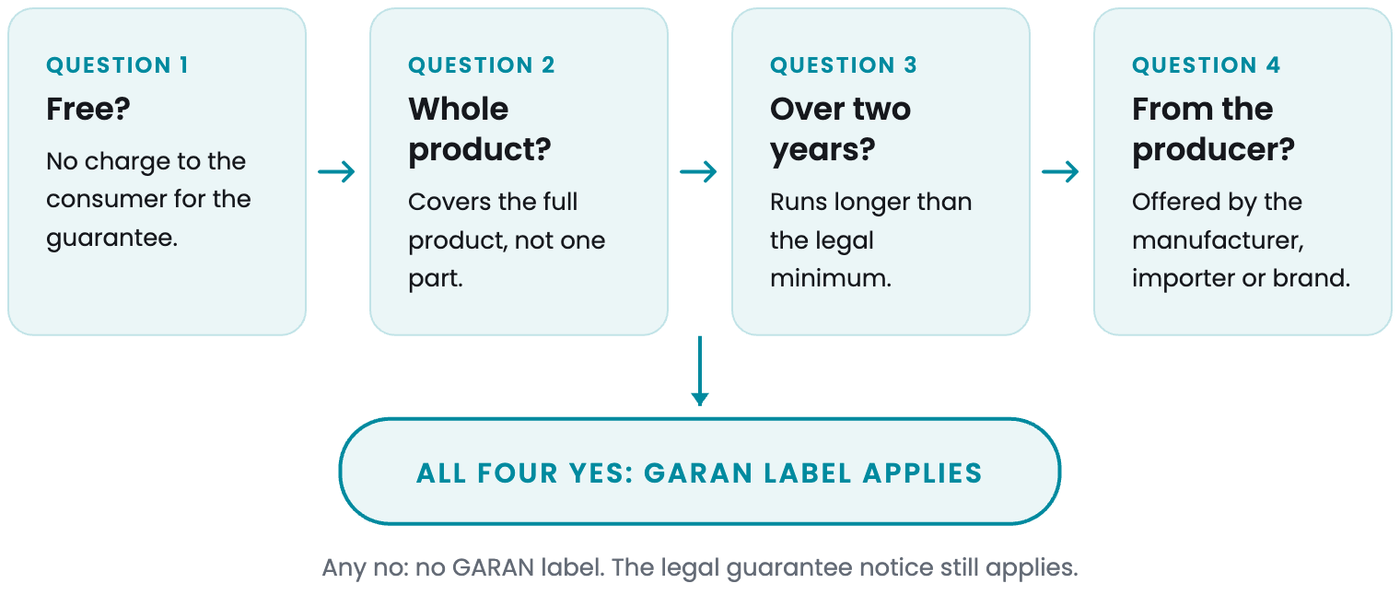
If all four conditions are met, the guarantee qualifies for GARAN, and sellers have to display the label once the producer makes the relevant information available. In EU consumer law, the producer is the manufacturer, the importer into the EU, or anyone who puts their own name or trademark on the goods. For most brands that means you, even when a factory elsewhere makes the product. Where the company is based does not matter: if you sell to consumers in the EU, the rules apply.
In practice, the label matters most for products built to last: furniture, mattresses, appliances and electronics. A free ten-year guarantee on a whole sofa qualifies. In fashion, most products simply carry the legal guarantee; the likeliest exceptions are workwear and outdoor brands with durability test data behind a longer promise.
These do not qualify for the GARAN label:
- A paid extended warranty, however long it runs.
- A partial guarantee, such as a lifetime warranty on a frame, sole or zip alone.
- Cover that shrinks over time, such as five years where the customer pays half the repair cost from year three.
- Two years or less. This does not qualify for GARAN. Such a guarantee can still offer extra benefits, but traders must not present existing statutory rights as a distinctive benefit of their offer, which is banned under the new greenwashing rules.
What does the GARAN label show and where does it go?
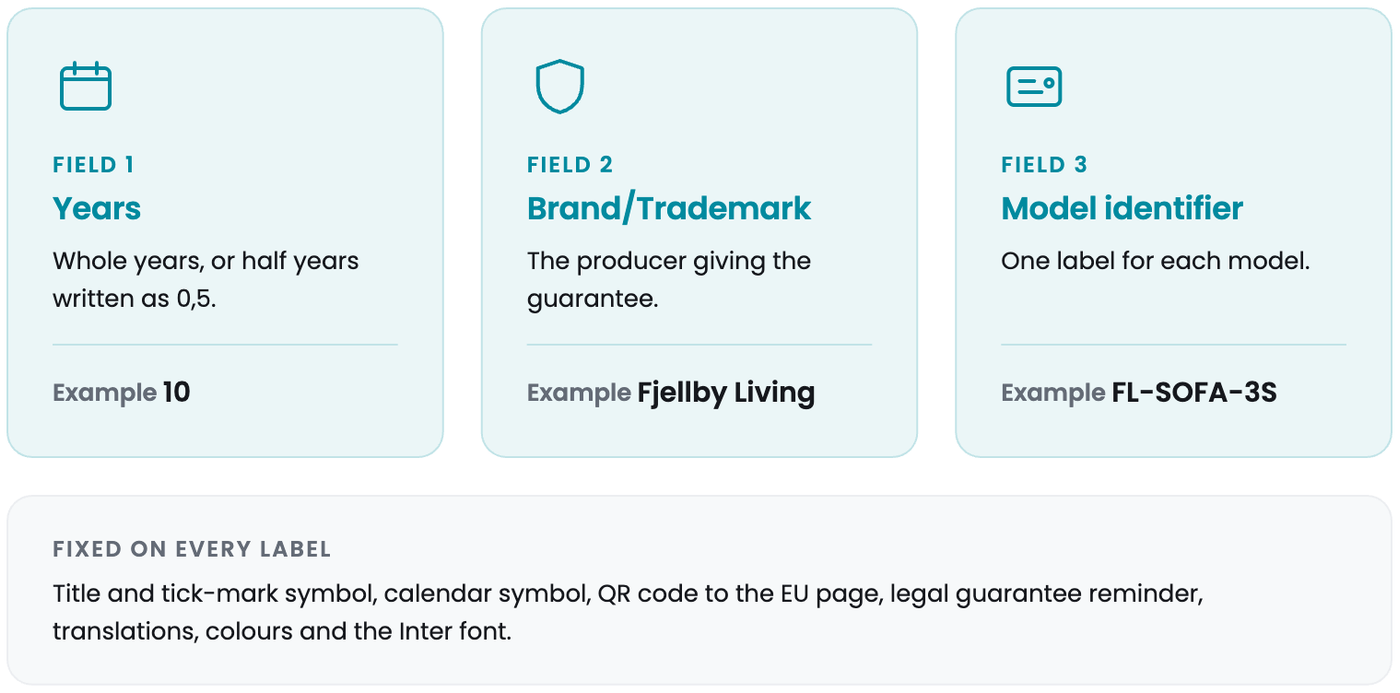
Only three fields on the label can change. Here is how a fictional furniture brand would fill them in for a sofa with a free ten-year guarantee.
Everything else is fixed: the title with its tick-mark symbol for guaranteed durability, the calendar symbol, the reminder that the legal guarantee still applies, the QR code to the EU's page on durability guarantees, the translations of "producer guarantee in years", the colours and the Inter font.
One label covers one model, so the same guarantee on 40 models means 40 labels.
Start from the official files. The European Commission publishes practical guidelines and high-resolution files for the notice in every EU language, and for the label in colour, black and white and the compact online version.
The label tells shoppers the guarantee exists; the guarantee statement sets out its terms. EU law requires that statement in plain language, on a durable medium such as a PDF or printed card, by the time the product is delivered.
It must say the consumer's legal rights are unaffected, name and address the guarantor, explain how to claim, and list the products and conditions covered. If your advertising promises more than the statement, the advertising terms bind you.
And the promise runs to its final day: if the sofa from the example fails in year nine under normal use, the producer remains liable for free repair or replacement, subject to the applicable rules and the cover the guarantee provides.
What does the GARAN label mean for retailers?
The guarantee is the producer's choice, but retailers end up doing much of the work. Picture a retailer stocking sofas from a producer that offers a free ten-year guarantee. The retailer never chose that guarantee, yet once the producer provides the information, it has to show the GARAN label in its stores and on its website for every one of those models.
Retailers only have to show the label when the producer gives them the information; they do not have to go looking for it.
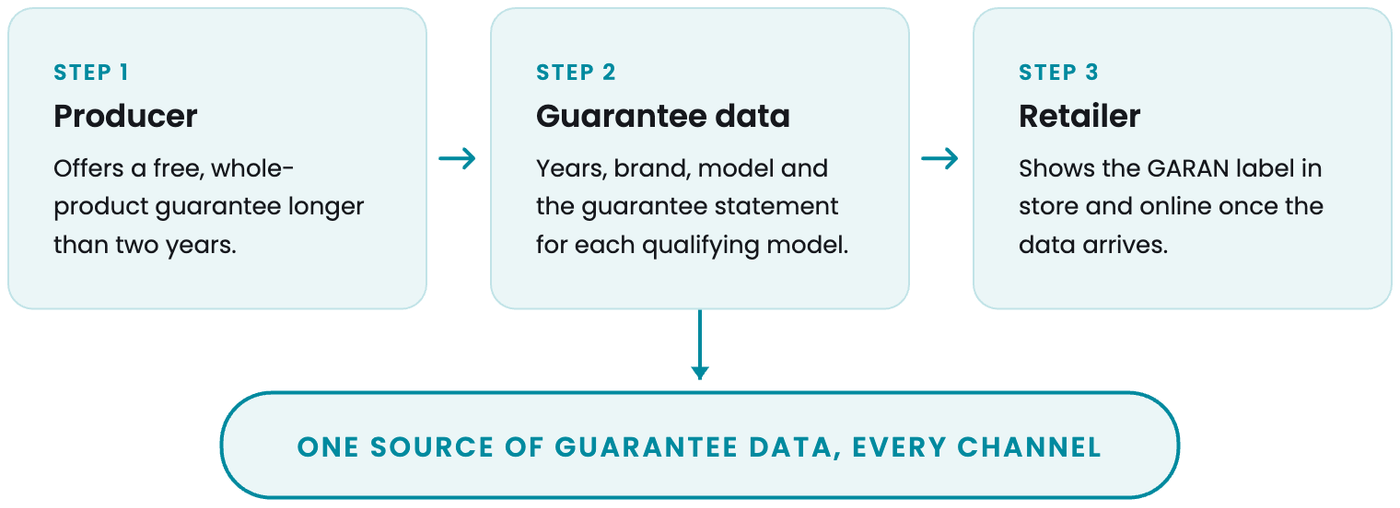
For a retailer with many suppliers, it still turns into a data task: knowing which models carry a qualifying guarantee, holding the duration, brand and model for each, keeping the guarantee statements, and updating labels when products change. Brands selling through retailers make their guarantee visible by sending that data in the product feed they already share.
How do the rules differ by country?
The notice and the label look the same everywhere: the EU fixes the design, and the label already carries its key words in every official EU language. What differs is the national law around them.
- 27 March 2026Deadline for Member States to adopt national law; most miss it
- 28 May 2026Commission opens infringement proceedings against 20 Member States
- 27 September 2026The rules apply; sellers show the notice and, for qualifying guarantees, the GARAN label
- 1 January 2027Proposed start in Sweden; no bill yet
- 27 September 2027Polish rules set to apply, a year after the EU date
Every country had to adopt its law by 27 March 2026; most missed that date, and on 28 May 2026 the European Commission opened infringement proceedings against 20 of them. Several have caught up since. The statuses below are as at 16 October 2026.
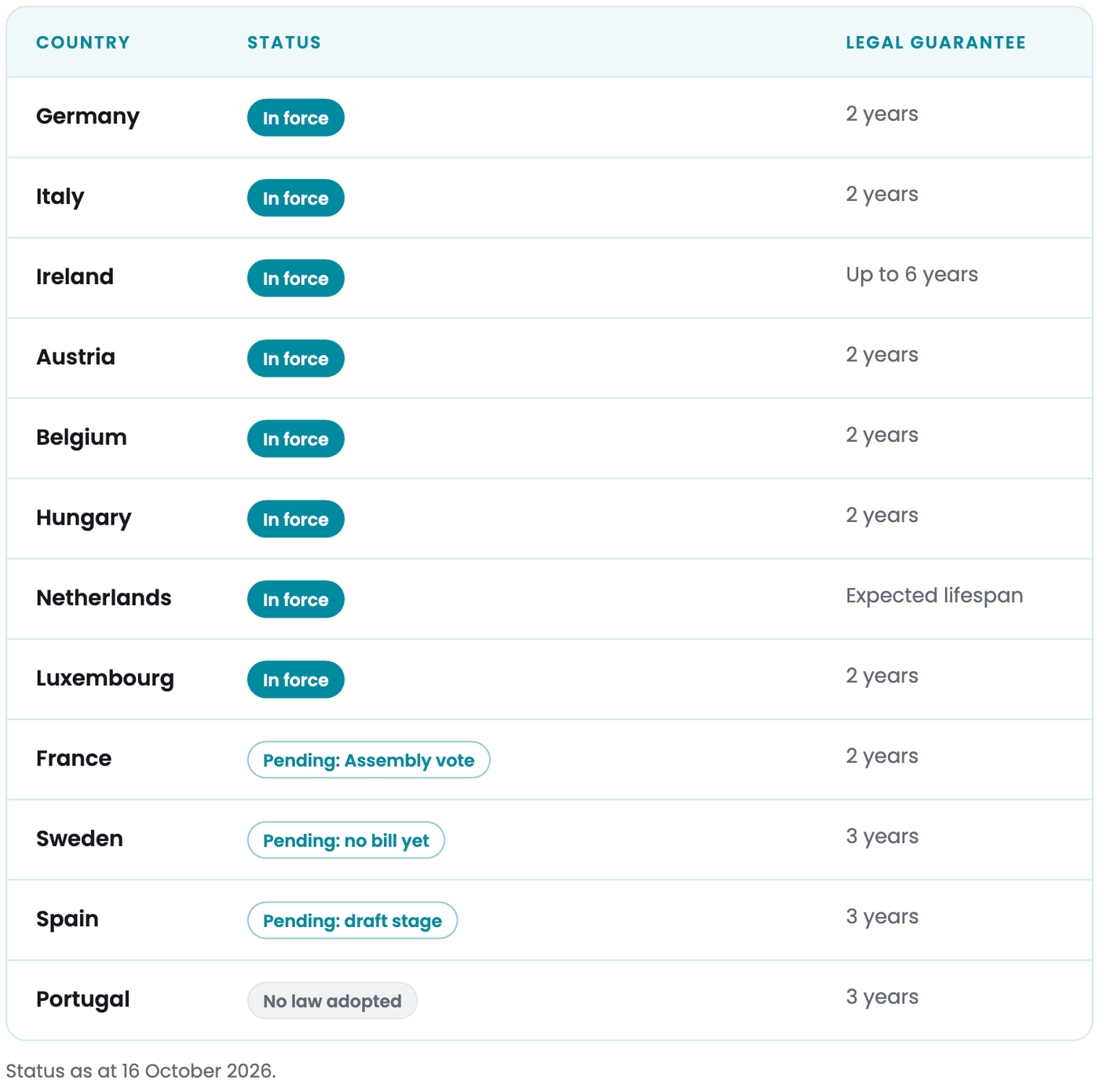
Finland, like the Netherlands, ties the legal guarantee to how long a product should reasonably last. Bulgaria, Czechia and Slovenia were also still listed as not implemented at the last check. Romania transposed in March 2026, through an emergency ordinance published on 26 March 2026. Poland passed its implementing law in the Sejm on 4 September 2026, but the Polish rules are set to apply from 27 September 2027, a year after the EU date.
The notice shows the EU minimum and cannot be edited, so sellers in countries with longer rules often add a separate line beside it with the national period.
A three-year GARAN guarantee also adds less in Spain, Portugal or Sweden, where shoppers already get three years from the seller. What it adds there is that the producer is directly liable.
National implementation and enforcement arrangements differ. Check the rules that apply to your sales, including cross-border sales, rather than assuming that delayed implementation removes all compliance risk.
What are the penalties?
Each country enforces these rules through its own consumer authority and sets its own penalties. There is one EU-wide floor, and it is narrower than it looks. It comes from Article 24 of the Consumer Rights Directive and applies only where penalties are imposed in an EU coordinated action over a widespread infringement, meaning harm across several Member States. In those cases national law must make available maximum fines of at least 4% of the trader's relevant annual turnover, or at least €2 million where turnover information is unavailable. An ordinary cross-border breach does not meet that threshold, and outside those cases the level of the fine is a matter for national law.
In Germany, the biggest market for these rules, the most likely consequence is not a regulator's fine. German chambers of commerce warn traders to expect warning letters (Abmahnungen) from competitors and consumer associations, with fines possible in serious cases. Warning letters are quick and cheap to send, so a missing notice or a wrong label is a real risk there.
The "two years or less" mistake above already has case law behind it: German courts, up to the Federal Court of Justice, have treated advertising statutory rights as if they were the seller's own promise as misleading.
- Every seller can be penalised for not showing the legal guarantee notice.
- Producers are not penalised for choosing not to offer a durability guarantee, but once they offer one they must repair or replace for the whole period.
- Retailers only have to show a GARAN label when the producer provides the information.
What comes next?
The core rules are set, but several pieces are still moving:
- France still needs its National Assembly vote and a decree setting the conditions for showing the GARAN label.
- Sweden has a proposal to start on 1 January, but no bill yet.
- Spain and Portugal have not yet adopted laws, and the Commission's infringement cases can move to the next stage.
- Right to repair. Countries had to bring in the EU right-to-repair directive by 31 July, and several are doing it alongside these rules. It adds duties on repair and spare parts that sit right next to any durability guarantee.
- Repair information for more products. Retailers already have to share repair information when the producer supplies it, but the official repairability score exists only for smartphones and tablets so far. More product groups are expected.
- First enforcement in Germany. The first warning letters and court decisions will show how strictly placement, colour and design are checked.
- A possible review of the label. The regulation lets the Commission revisit the GARAN label depending on how widely brands use it.
What should you do now?
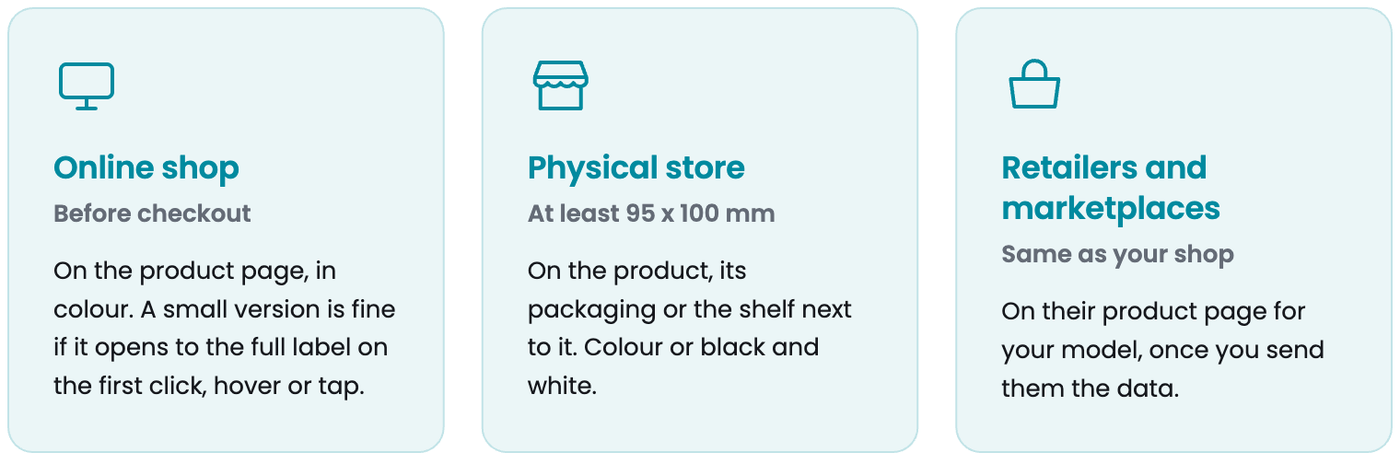
- Show the legal guarantee notice in your online shop in colour, in full or opening in full on the first click or mouse-over from a prominent legal guarantee reminder, and in every store at A4 or larger.
- List every product where you offer a guarantee longer than two years, and check it is free and covers the whole product.
- Write or update the guarantee statement for each qualifying guarantee.
- Fill in years, brand and model for each qualifying model, using the official files.
- Display the label prominently on product pages and in stores, using a placement such as the product, its packaging or the shelf.
- Send the guarantee data to your retailers and marketplaces.
- Check the national rules in each country you sell to, including longer legal guarantee periods.
GARAN label FAQ
Is the GARAN label mandatory?
The guarantee is voluntary, but the label is not. Once a producer offers a free, whole-product guarantee longer than two years, the label must be used to show it. The legal guarantee notice is mandatory for every seller.
What does GARAN mean?
It is not an acronym. According to the regulation, it refers to the word for guarantee in several EU languages, so one name works across the EU.
Where can I download the GARAN label?
From the European Commission's page of practical guidelines and high-resolution files. Use those files rather than redrawing the label.
Can I add my logo or brand colours?
No. Your brand name goes in the Brand/Trademark field, and that is the only place it appears.
Where does the QR code lead?
To the EU's Your Europe page on durability guarantees, not to your website. You cannot change it.
Do non-EU brands need it?
Yes, if they sell to consumers in the EU and offer a qualifying guarantee.
Is the legal guarantee always two years?
No. Two years is the EU minimum. Spain, Portugal and Sweden give three years, the Netherlands and Finland tie it to expected lifespan, and in Ireland claims can run for up to six years.
Where does the Digital Product Passport fit?
The GARAN label tells a shopper how long a product is guaranteed, but its QR code goes to a general EU page, not to the brand. The guarantee terms, product registration and the claims process still need a place shoppers can find them.
Digital Product Passports are one place this kind of product information can live, next to care, materials and repair details. Whatever system you use, the label, the product page, the guarantee statement and your retailer feeds should come from one source of guarantee data, so they never contradict each other.
This is general information, not legal advice. Member States implement and enforce these rules through national legislation, so specific requirements and penalties may vary by country. Consult qualified legal counsel before relying on this information for a compliance decision. The label in the cover image is an illustration; Fjellby Living and model FL-SOFA-3S are fictional.
Sources
- Commission Implementing Regulation (EU) 2025/1960 (EUR-Lex)
- European Commission: practical guidelines and high-resolution files for the notice and label
- Directive (EU) 2019/771 on the sale of goods, Article 17 (EUR-Lex)
- European Parliament summary of the Omnibus Directive on consumer law enforcement
- CMS Implementation Tracker for the EmpCo Directive
- Austria: Consumer Rights Amendment Act (RIS)
- Netherlands: Senate file 36873
- Luxembourg: Law amending the Consumer Code (Legilux)
- Sweden: government inquiry proposal
- French Senate: amendment on the harmonised guarantee label
- Spanish government: the three-year legal guarantee
- Portugal: the three-year legal guarantee
- European Consumer Centre: legal guarantee periods by country
- CCPC: your rights when goods are faulty (Ireland)
- IHK: guarantee information duties for German retailers
- German Federal Court of Justice on advertising statutory rights as a seller's own guarantee (Rechtslupe)
DPP updates, monthly.
Regulation changes and product news. No spam.

 Bas van der Pol

